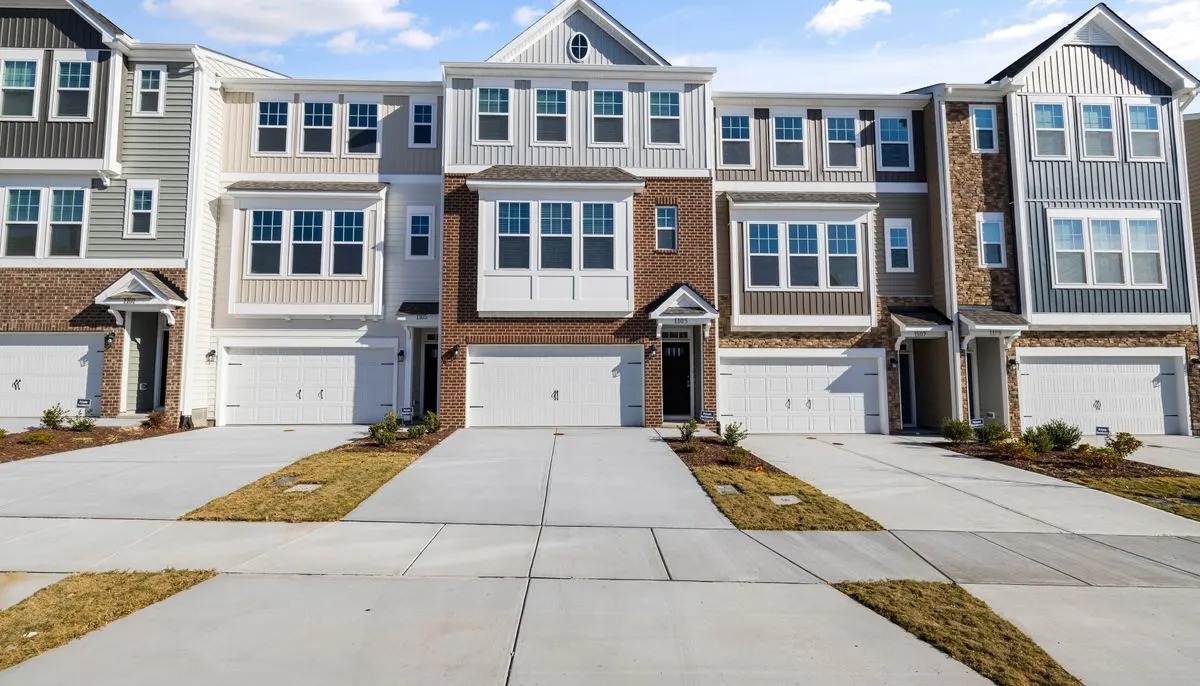
A Fort Worth DSCR loan is underwritten off the property's own income, so no lender asks for a tax return, a W-2, or a debt-to-income ratio. What every lender does ask is whether the rent covers the payment — and in Tarrant County that payment carries an unusually heavy ad valorem load. A City of Fort Worth address inside Fort Worth ISD stacked a composite tax rate of roughly 2.16% of assessed value in tax year 2025, per rates published on the Tarrant County entity portal, and every basis point of it sits in the denominator of your coverage test. Two different products also hide behind the one phrase: residential DSCR below five units, agency or bank debt at five and up. Our guide to DSCR loans in Texas carries the statewide rules. This piece is about what Tarrant County does to the arithmetic.
The coverage test, worked on a Fort Worth fourplex
A Fort Worth DSCR test divides the building's income by its full monthly payment, and below five units that payment includes principal, interest, taxes, insurance, and any association dues. Clear the coverage lenders generally want, which NerdWallet's DSCR guide puts at around 1.25 or higher, and the file moves. Miss it, and more equity is the only lever.
Here is the arithmetic on an illustrative Fort Worth fourplex. Rent is anchored to the $1,470 per unit effective rent Cushman & Wakefield reported for Dallas–Fort Worth in Q2 2026, and the tax line uses the Tarrant County composite rate. Every other input is a stated assumption, not a market figure.
| Line item | Monthly | Basis |
|---|---|---|
| Line item Gross rent, 4 units × $1,470 | Monthly $5,880 | Basis Q2 2026 DFW effective rent (Cushman & Wakefield) |
| Line item Principal and interest | Monthly $3,581 | Basis Assumed $525,000 loan, 7.25%, 30-year amortization |
| Line item Property taxes | Monthly $1,262 | Basis 2.16% composite 2025 rate, assumed $700,000 assessed value |
| Line item Insurance | Monthly $375 | Basis Assumed hail and hazard coverage |
| Line item Total PITIA | Monthly $5,218 | Basis Denominator of the test |
| Line item DSCR | Monthly 1.13x | Basis $5,880 divided by $5,218 |
At 75% leverage that file fails a 1.25x test. It is not a bad building — it is a building carrying a North Texas tax bill.
What the tax line alone is worth: hold rent, rate, and insurance constant and drop the tax rate to a hypothetical 1.2%, and the payment falls to $4,656 and the ratio rises to 1.26x. The Tarrant County load by itself swings coverage about 0.14x, which is the whole distance between a decline and an approval.
What actually fixes it: equity. Holding rent and rate constant, the loan has to come down to roughly $450,000 — about 64% of that $700,000 basis — before the ratio reaches 1.25x. In Fort Worth the down payment is set by the tax bill, not by the program's LTV cap. Sizing your deal backward from the ratio, rather than forward from a leverage number you hope to hit, is the single habit that saves the most wasted applications.
Why does the Tarrant County tax bill land inside your DSCR?
The DSCR test measures the payment, not the loan, and in Tarrant County the tax line is often the second-largest item in that payment after principal and interest. A Fort Worth address stacks five separate taxing units, and their composite rate reached 2.16% of assessed value in tax year 2025.
The stack is not one bill from one authority. It is five, and the school district is the largest piece of it:
| Taxing unit | 2025 rate per $100 of value |
|---|---|
| Taxing unit Fort Worth ISD | 2025 rate per $100 of value 1.029100 |
| Taxing unit City of Fort Worth | 2025 rate per $100 of value 0.670000 |
| Taxing unit Tarrant County | 2025 rate per $100 of value 0.186200 |
| Taxing unit JPS Health Network (hospital district) | 2025 rate per $100 of value 0.165000 |
| Taxing unit Tarrant County College District | 2025 rate per $100 of value 0.112280 |
| Taxing unit Composite | 2025 rate per $100 of value 2.162580 |
All five figures are the tax year 2025 rates published on the Tarrant County entity portal; the composite is their sum. A property in a different city or a different school district inside Tarrant County will stack a different total, which is why two Fort Worth-area fourplexes with identical rent rolls can underwrite to different ratios.
Why the escrow makes it unavoidable: on agency small-loan product, tax and insurance escrows are generally required, so the tax bill is not something a borrower can defer or self-manage into a better-looking payment. It is collected monthly, and it is in the denominator monthly.
Why the assessed value matters as much as the rate: the rate is fixed by the taxing units, but the value is not. A new purchase frequently gets reassessed toward the sale price, so the tax line an underwriter models for year one is often higher than the seller's trailing bill. Underwriting to the seller's old tax statement is the most common way a Fort Worth DSCR file that looked fine at application comes back short at closing. Statewide market context sits on our Texas market page.
Two-to-four units and five-plus are two different loans
The unit count decides which lending system you are in, and the dividing line in Fort Worth sits between four units and five. At four and below the file is residential non-QM, priced off gross rent and PITIA. At five and above it is commercial or agency debt, underwritten on net operating income.
Below five units: the test is gross rent over PITIA, the appraisal carries a rent schedule, and the loan is written against the borrower's entity with a personal guarantee in most cases. This is the product for a duplex in Fairmount or a fourplex off Hemphill.
Five units and up: Freddie Mac's Optigo Conventional Small term sheet runs generally $2 million to $10 million against predominantly market-rate properties of 5 to 50 units, with 5-, 7-, 10-, 12- and 15-year terms, amortization out to 30 years, and non-recourse treatment except for standard carve-out provisions. The borrower must be a single purpose entity — a limited partnership, corporation, limited liability company, or a tenancy in common with five or fewer tenants in common — and the application fee is 0.1% of the loan amount.
Why the split matters in Fort Worth specifically: the metro builds five-plus, not small-plex. Census Bureau Building Permits Survey data for annual 2025 shows Dallas–Fort Worth–Arlington authorized 24,607 units in buildings of five units or more — second nationally behind New York–Newark–Jersey City and first among Sun Belt metros — against just 1,228 units in duplexes and 554 in three- and four-unit buildings. A Fort Worth investor shopping 2-4 units is competing for existing stock in older neighborhoods, not buying new product. That has underwriting consequences: deferred maintenance, older roofs, and rent rolls that need a lease-by-lease read rather than a pro forma.
What does a Fort Worth DSCR file actually have to prove?
It has to prove that the property performs, that the sponsor is not a credit risk, and that the numbers on the rent roll are real. Leases, a trailing operating statement, the Tarrant County tax statement, a bound insurance quote, entity documents, and reserves carry the file. Personal income does not appear.
The rent roll and the leases: signed, current, and reconciled to deposits. Projected or pro forma rents rarely carry a residential DSCR file on their own; most programs will underwrite the lower of actual and market.
The tax statement: pulled from Tarrant County, not from the listing. Underwriters model forward, not backward.
The insurance binder: North Texas is a hail market, and a quote that has not been bound can move several hundred dollars a month between application and closing — enough to move the ratio.
Reserves and credit: typically several months of payments held in a documented account, plus a credit report. These are the two places where the sponsor still gets underwritten.
What is absent: W-2s, personal or business tax returns, pay stubs, and a debt-to-income calculation. That is the actual trade — you give up personal-income underwriting and take on a property that has to carry itself from day one.
Rates, leverage, and the 2026 lending backdrop
Capital is available and priced more competitively than a year ago, but lenders are giving ground on spread rather than on leverage. That distinction matters to a Fort Worth DSCR borrower, because the binding constraint on your deal is proceeds, and proceeds are exactly what the market has tightened.
Lending momentum: CBRE's Lending Momentum Index stood at 1.0 at the end of Q2 2026, down from 1.3 a year earlier, even as the number of loans closed rose 11% year over year.
Multifamily leverage: average multifamily LTV ratios eased to 63.3% in Q2 2026 from 65.8% a year earlier, per CBRE — a direct headwind for a borrower whose ratio already needs a bigger down payment.
Multifamily spreads: multifamily mortgage spreads tightened 15 basis points year over year to 162 basis points in Q2 2026, also per CBRE. Cheaper spread, less leverage.
The numerator is soft, too: Dallas–Fort Worth average asking rents were $1,509 in January 2026, down 1.9% year over year, with occupancy at 92.9% at the end of 2025 and average pricing of $167,974 per unit, per CRE Daily.
Read those together and the picture is coherent rather than alarming. Debt is obtainable and reasonably priced; what has moved against a Fort Worth DSCR borrower is the amount of it, and a rent line that is not currently doing the work of lifting coverage for you. Neither of those is a forecast — they are the conditions in the most recent reported quarter, and they argue for underwriting your own file conservatively rather than waiting for the market to bail out a thin ratio. Our Dallas–Fort Worth market page tracks the metro-level picture, and the Fort Worth market page the city itself.
Where the deals are: Fort Worth submarkets
Fort Worth is not one rental market, and the vacancy spread across Tarrant County submarkets is wide enough to change a coverage ratio on its own. The north side runs tighter than the metro average, the historic inner neighborhoods hold most of the small-plex stock, and Arlington sits between them.
North Fort Worth: stabilized vacancy of 7.1% in Q2 2026 against a 9.6% metro-wide stabilized rate, per Cushman & Wakefield. Financeable here: stabilized garden-style product where the occupancy line supports the rent assumption an underwriter will actually credit.
Grapevine: 5.5% vacancy in Q2 2026, the lowest in the metro per the same report. Occupancy is not the constraint in northeast Tarrant County; basis is. Coverage tends to fail on price, not on vacancy.
Near Southside and Fairmount: Fort Worth's historic inner neighborhoods hold much of the metro's genuine 2-4 unit stock. This is where residential DSCR product actually applies, and where condition — not rent — is usually the reason a file dies. A property that is not rent-ready generally needs bridge or renovation debt first, then a DSCR takeout.
Arlington: Tarrant County's second city and a large rental base in its own right, sitting between the Dallas and Fort Worth job cores. Both residential and five-plus files trade here; treat submarket rent assumptions as address-specific rather than metro-wide.
The Alliance corridor and far north Fort Worth: newer product and newer basis. Deals here more often pencil as five-plus agency or bank files than as small residential DSCR loans, simply because that is what has been built.
The bottom line
A Fort Worth DSCR loan qualifies the building, and the building has to carry a Tarrant County tax bill that reached a 2.16% composite in 2025. That single line is worth roughly 0.14x of coverage on this guide's illustrative fourplex — enough to turn a 75% leverage request into a 64% one. Size the deal backward from the ratio, model the tax line forward rather than off the seller's statement, and know which side of the four-to-five unit line you are on before you apply. For the Houston version of the same math under a different tax and insurance load, see our Houston DSCR loan guide.
YieldStack is a commercial mortgage brokerage. YieldStack arranges commercial real estate financing nationwide. The search covers 20,000+ loan programs, and a submitted file returns 5–8 matches with a median first offer in under an hour. It costs Zero upfront to submit a deal and review offers; YieldStack's broker fee is 0.50–1.00% of the loan amount and is paid only at closing. Every credit decision is made by the lender; YieldStack arranges the introductions and negotiates on the borrower's side, and no loan, rate, or closing is guaranteed. To see what your Fort Worth rental actually supports, run your deal through lender match, or Submit Your Deal →