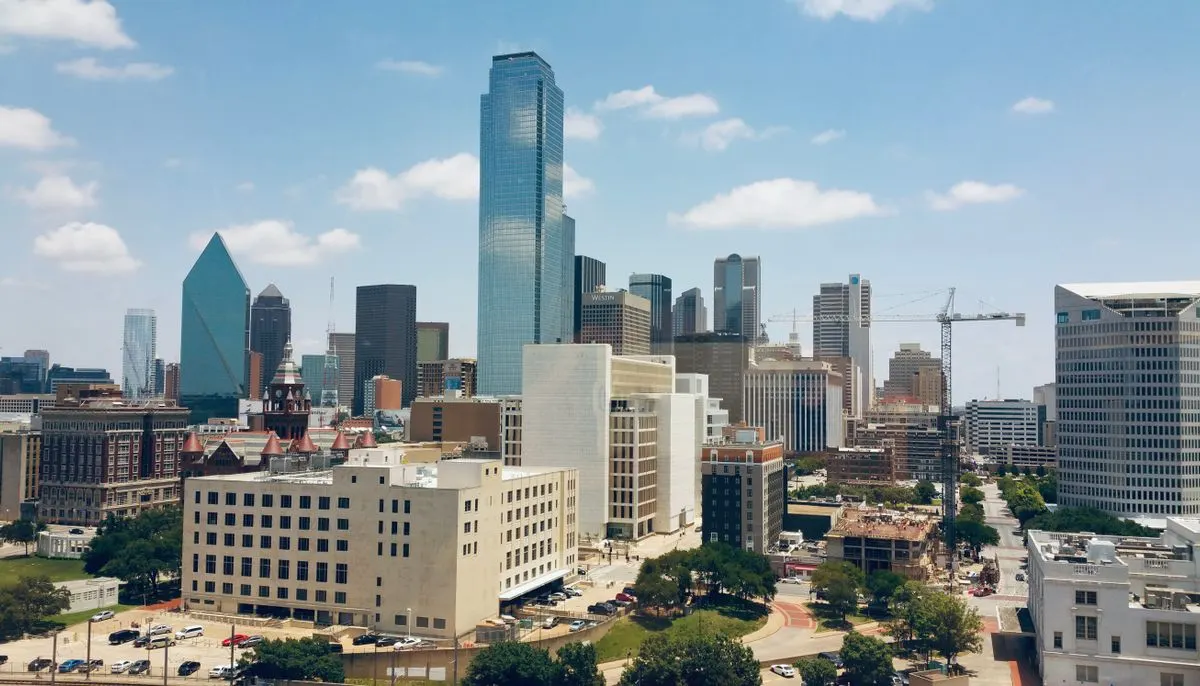
Dallas–Fort Worth permitted 786 buildings with five or more units in 2025 — second only to New York–Newark–Jersey City nationally, and first among Sun Belt metros — according to the Census Bureau's Building Permits Survey final annual data. Those 786 buildings contained 24,607 units, an average of about 31 units each, which means the typical permitted DFW multifamily project is a mid-sized building rather than a tower. Financing one is a city-specific exercise: the lender pool, the leverage that actually clears, the draw cadence and the takeout path all behave differently in North Texas than they do in Houston or on either coast. This guide walks that process for 5-to-50-unit deals.
Why Dallas–Fort Worth is a construction-lending market of its own
Dallas–Fort Worth led every metro except New York in 2025 multifamily permitting, and it led the Sun Belt outright, but the more useful fact for a borrower is the size distribution sitting behind that headline total. The metro's 786 permitted buildings averaged roughly 31 units each — small-balance territory, financed by a different lender set than the towers.
That average tells you which desk your file lands on. A 24-unit building in Oak Cliff and a 300-unit wrap in Frisco are both "DFW multifamily construction," but they are underwritten by different institutions, at different leverage, on different timelines.
Table: 2025 multifamily permitting, selected metros (U.S. Census Bureau, Building Permits Survey, final annual data released May 14, 2026)
| Metro | Buildings with 5+ units | Units in those buildings | Average units per building |
|---|---|---|---|
| Metro New York–Newark–Jersey City, NY-NJ | Buildings with 5+ units 990 | Units in those buildings 31,550 | Average units per building ~32 |
| Metro Dallas–Fort Worth–Arlington, TX | Buildings with 5+ units 786 | Units in those buildings 24,607 | Average units per building ~31 |
| Metro Atlanta–Sandy Springs–Roswell, GA | Buildings with 5+ units 585 | Units in those buildings 11,052 | Average units per building ~19 |
| Metro Houston–Pasadena–The Woodlands, TX | Buildings with 5+ units 477 | Units in those buildings 16,385 | Average units per building ~34 |
| Metro Phoenix–Mesa–Chandler, AZ | Buildings with 5+ units 407 | Units in those buildings 14,800 | Average units per building ~36 |
What this means for a sponsor: DFW's rank is a supply-side signal, not a demand promise. Lenders here see multifamily construction files constantly and hold current comparables, which shortens diligence.
How DFW differs from its Texas sibling: Houston permitted 477 five-plus-unit buildings holding 16,385 units in 2025 — fewer buildings, slightly larger on average. The two markets are not interchangeable when picking lenders or sizing an exit; the Houston multifamily construction financing guide covers that market on its own terms. Statewide context for both metros sits on our Texas market page.
Who lends on a 5–50 unit DFW construction deal
Four lender types quote small multifamily construction in North Texas, and which one fits depends less on your rate preference than on your balance sheet, your general contractor's record and how firm your takeout is. Regional and community banks, debt funds, credit unions and — for larger sponsors — forward-committed permanent lenders make up the practical pool.
Regional and community banks: the default source for a 5-to-50-unit ground-up deal. They want recourse, a deposit relationship, a completed GC contract and a sponsor who has built in the metro before. Bank appetite is measurably wider than a year ago: CBRE reported on August 3, 2026 that banks took 30% of non-agency loan closings in Q2 2026, up from 24% a year earlier, and the Mortgage Bankers Association reported on August 6, 2026 that depository originations rose 61% year over year in the same quarter.
Debt funds and private construction lenders: faster, more expensive, and more tolerant of a first-time sponsor or an unusual site. CBRE put alternative lenders at 38% of non-agency closings in Q2 2026, up from 34% a year earlier — the largest single share of that market. Expect a shorter term and tighter completion covenants in exchange for the speed.
Credit unions: active at the smaller end of North Texas multifamily, usually for member-sponsors with local operating history. Terms are competitive; member eligibility and legal lending limits cap deal size.
Forward-committed permanent lenders: relevant when a sponsor can bring a permanent commitment before breaking ground, which moves refinance risk off the construction lender. This is a large-sponsor structure, rarely available on a 20-unit file.
Loan-to-cost, cost basis and the structure that clears in DFW
Loan-to-cost is the ratio a construction lender quotes, but in this market it functions as an output rather than an input: the lender sizes the loan backward from what a permanent lender will advance at completion. Get the takeout math right and the LTC conversation resolves itself; get it wrong and no leverage argument helps.
The binding constraint: CBRE's Q2 2026 figures show what the permanent market will actually do. Multifamily loan-to-value averaged 63.3%, down from 65.8% a year earlier, with debt service coverage at 1.43 (up from 1.34) and debt yield at 10.2% (up from 9.7%). Those three tests, applied to your stabilized net operating income, set the ceiling on the construction loan long before anyone argues about cost percentages.
What the permit file says about DFW cost basis: the 2025 Building Permits Survey recorded about $4.13 billion of construction valuation across those 24,607 DFW units — roughly $168,000 per unit. Treat that as a floor, not a budget: permit valuation is the figure filed with the city and generally excludes land, financing costs and much of the soft-cost stack. It is still a useful reality check on a pro forma that assumes materially less.
Recourse, not rate, is the negotiation: on small-balance DFW construction, the spread between lenders is usually narrower than the spread between their guarantee packages. Completion guarantees are near-universal; the live questions are how much repayment recourse burns off, and what performance test releases it.
For the underlying sizing mechanics — structure, the takeout gap and how to close it — the general multifamily construction loan guide works through the math in detail.
Where the deals are: Dallas–Fort Worth submarkets
Permit data splits Dallas–Fort Worth into two different financing markets, and the dividing line is average project size rather than geography or rent. Thirty-two separate DFW places recorded five-plus-unit permits in 2025, and the per-building averages inside them range from five units to well over a hundred.
Dallas (city): 346 buildings, 4,883 units — about 14 units per permitted building, the densest concentration of genuinely small multifamily construction in the metro, and squarely bankable at a community or regional bank. Infill sites here are the natural home for a 12-to-40-unit file.
Fort Worth: 105 buildings, 3,348 units — roughly 32 units per building, right at the metro average. Deep enough for a mid-sized ground-up deal without competing against institutional capital for every site.
Denton: 50 buildings, 2,508 units — about 50 units per building, at the top edge of the 5-to-50-unit band. Student-adjacent and workforce product dominates, and lenders will underwrite lease-up seasonality explicitly.
McKinney: 64 buildings, 1,391 units — around 22 units per building, a suburban submarket still permitting small buildings rather than only large ones, which keeps regional banks engaged.
Grand Prairie: 38 buildings, 240 units — about six units per building, the smallest average among the six DFW places with the most permitted buildings. Bankable, but small enough that some construction lenders' minimum loan sizes screen these deals out entirely.
Frisco: 33 buildings, 4,562 units — roughly 138 units per building, institutional territory rather than small-balance. A 5-to-50-unit sponsor competing for land here is competing against a very different cost of capital.
One structural change is worth knowing before you site-select. Texas Senate Bill 840, enacted in September 2025, allows multifamily to be built by right in commercially zoned areas without a zoning hearing in cities above 150,000 residents located in counties above 300,000 residents; per Bisnow's May 14, 2026 reporting, most of the 19 affected cities are in North Texas. Where it applies, it removes an entitlement risk that construction lenders have historically priced.
What do current rates mean for a DFW construction budget?
Construction loans in this metro price off a floating short-term index while the takeout that repays them prices off the long end, so a sponsor carries exposure to two different curves at once. Both are worth checking before you set an interest reserve or sign a term sheet.
Short end: SOFR, the reference rate under most floating construction loans, was 3.68% on August 31, 2026 (Federal Reserve Bank of St. Louis). That is the number your interest reserve has to survive across the build, before spread.
Long end: the 10-year Treasury constant maturity rate was 4.73% on August 28, 2026 (Federal Reserve Bank of St. Louis). Your permanent takeout is priced off that curve plus a spread, and it is the rate your stabilized coverage test has to clear.
Market temperature: CBRE's Lending Momentum Index stood at 1.0 at the end of Q2 2026, easing from a five-year high of 1.5 in Q1 2026 and 1.3 a year earlier, while multifamily loan spreads tightened 15 basis points year over year to 162 bps. The MBA reported total commercial and multifamily originations up 16% year over year and 12% quarter over quarter in Q2 2026, with multifamily originations up 8% year over year and 15% versus Q1.
The practical consequence is that the interest reserve — not the headline rate — is where most DFW construction budgets go wrong. The construction draw schedule guide covers how reserves are sized against a draw curve and how fast they burn when the schedule slips.
Which takeout path should you underwrite from day one?
Three takeout paths repay a DFW small multifamily construction loan — agency permanent debt, a bank or insurance-company permanent loan, or a sale — and each one imposes different completion covenants in the construction documents. Pick the path before you close the construction loan, because the exit dictates what you have to build.
Recent origination data says something useful about which channels are actually funding. In Q2 2026 the MBA reported CMBS originations up 68% year over year and depository originations up 61%, while GSE volume fell 17% and life insurance company volume fell 27%. A takeout plan that assumes the agency channel will be as available as it was two years ago is making an assumption worth stress-testing.
Agency permanent debt: still the lowest-cost stabilized execution for conventional multifamily, but it requires a genuine stabilization period and clean unit-mix and amenity underwriting. Build to agency standards from the drawings forward, or you will discover the mismatch at certificate of occupancy.
Bank or insurance-company permanent: more flexible on property quirks, generally shorter term, and priced off the long curve. This is the realistic exit for a 20-to-50-unit building with an unusual footprint or a mixed ground floor.
Sale at stabilization: viable, but underwrite it against real lease-up conditions rather than a spreadsheet absorption rate. Bisnow reported on May 14, 2026 that DFW had about 43,000 units under construction in Q1 2026 after eleven consecutive quarters of declining construction activity, with roughly 22,000 units expected to deliver within the following year, and that suburban lease-ups were still running 12-week concessions and $1,000 gift cards. Concessions in your submarket at delivery are a takeout risk, not a marketing detail.
Running the process without stalling
A DFW construction file stalls in predictable places: an incomplete general contractor package, a takeout assumption nobody has tested, and a lender list assembled from whoever answered the phone. Fixing the first two is your work; the third is a distribution problem, and it is the one most sponsors solve last.
Have these ready before you approach any construction lender:
- A signed or near-final GC contract with a line-item budget and a schedule of values
- Entitlement status in writing, including whether the site qualifies for by-right multifamily under SB 840
- A sponsor and GC résumé showing comparable completed North Texas projects
- A stabilized pro forma tested against current permanent-market coverage and debt-yield standards, not last cycle's
- A named takeout path with the specific test it has to pass
YieldStack is a commercial mortgage brokerage. YieldStack arranges commercial real estate financing nationwide. A 5-minute submit through lender match puts a DFW construction file in front of 5–8 matches drawn from 20,000+ loan programs, with a median first offer in under an hour, Zero upfront, and a success fee of 0.50–1.00% payable only if you close.
The bottom line
DFW earned its permitting rank on ordinary buildings, not towers, and that is good news for a 5-to-50-unit sponsor: the lender pool here is deep in exactly the size class most construction lenders elsewhere treat as an exception. The rest is sequencing. Establish the takeout test first, size the construction loan backward from it, pick a submarket whose average project size matches the capital you can actually raise, and budget the interest reserve against the short rate you can see today. Sponsors who lose money on North Texas construction deals rarely lose it on the build — they lose it on an exit they never underwrote.