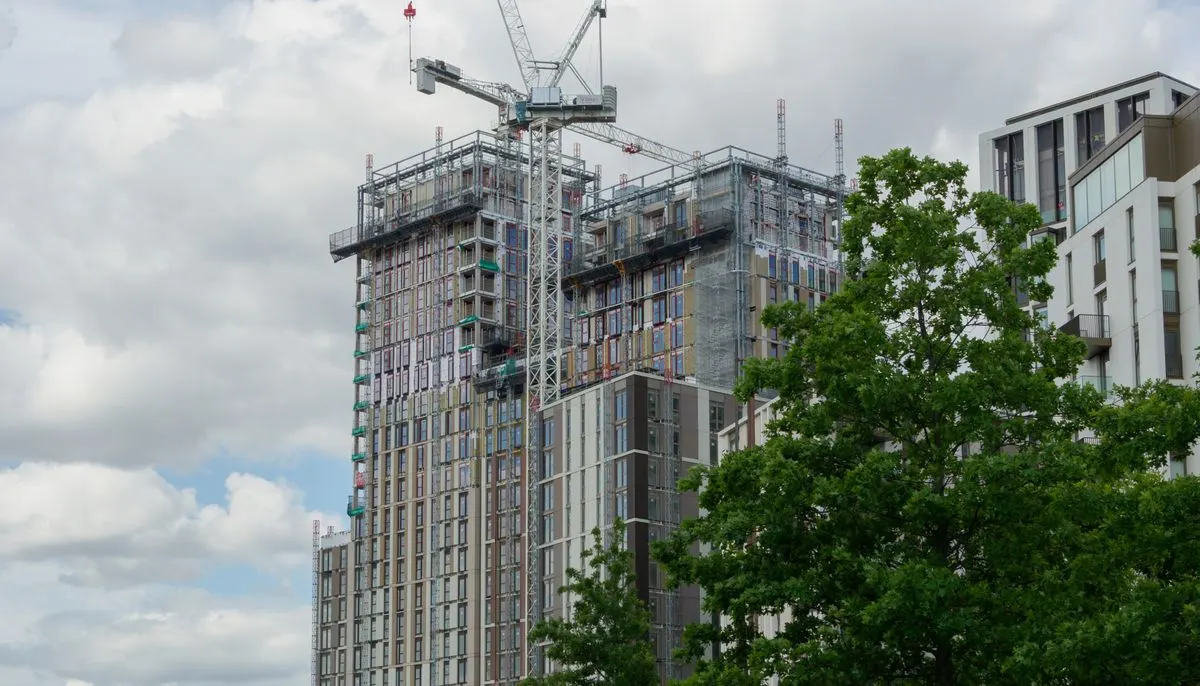
A multifamily construction loan in San Antonio funds land, hard costs, soft costs and an interest reserve against a completed-value appraisal, releasing money in draws as inspected work gets built. The local wrinkle is scale. San Antonio permits small buildings, so most construction requests here are small-balance deals rather than the 300-unit institutional financings that dominate Dallas and Houston coverage. That changes who lends, how the loan is sized, and which submarkets clear.
San Antonio permits small buildings, and that changes the loan you should ask for
San Antonio authorized 127 buildings with five or more units in 2025, averaging about 14.5 units per building, per the Census Bureau's Building Permits Survey. That scale pushes most local projects into small-balance construction lending, where regional banks and debt funds compete rather than life companies.
Average building size is a better predictor of your capital stack than metro population. A 14-unit average means the typical San Antonio permit is a garden walk-up or a small infill wrap, not a podium. Podium construction carries structured-parking cost, a longer schedule and a lender set that wants institutional-size checks. Walk-up construction at 12 to 40 units carries none of that, and it opens a lender bench that a Dallas sponsor pitching the same product would never see.
The practical consequence: do not copy a big-metro term sheet. Sponsors who bring a 250-unit template to a 24-unit Far West Side site get quoted like an institutional borrower and priced like a risk the lender does not understand. Bring the structure that matches the building.
Deal size that fits the market: small-balance, set by that sub-15-unit average Product that dominates permits: garden and small infill, not podium Lender bench that follows: regional and community banks, credit unions, private construction debt funds
Sizing the deal: what a San Antonio lender will actually fund
Construction lenders size a San Antonio deal against total project cost and completed value at once, funding land, hard costs, soft costs and an interest reserve, then releasing money only against inspected work. The completed-value test usually binds before the cost test, so appraisal rent assumptions matter more than the contractor's budget.
Two tests run in parallel. Loan-to-cost caps what the lender will advance against your total budget, and loan-to-stabilized-value caps what it will advance against the finished asset. Whichever produces the smaller number is your loan. In a market absorbing recent supply, the appraiser's rent and vacancy assumptions are conservative, which means the value test bites first and your equity requirement is set by an appraisal you have not seen yet.
That is why experienced sponsors underwrite the value test before they order the appraisal. Pull the actual leases at three comparable properties within two miles, not the asking rents. If your pro forma rent sits above achieved rent at the closest stabilized comp, expect the lender to trim the loan rather than argue.
Table: What a small-balance San Antonio construction request typically looks like
| Term | Typical shape on a 12–40 unit San Antonio project |
|---|---|
| Term Basis | Typical shape on a 12–40 unit San Antonio project Land, hard costs, soft costs, interest reserve, contingency |
| Term Sizing tests | Typical shape on a 12–40 unit San Antonio project Loan-to-cost and loan-to-stabilized-value, lesser of the two |
| Term Rate | Typical shape on a 12–40 unit San Antonio project Floating over SOFR; fixed quotes are the exception |
| Term Term | Typical shape on a 12–40 unit San Antonio project Construction period plus a lease-up tail, then refinance |
| Term Funding mechanic | Typical shape on a 12–40 unit San Antonio project Draws against inspection, title date-down and lien waivers |
| Term Recourse | Typical shape on a 12–40 unit San Antonio project Full recourse plus completion guarantee is the default |
| Term Reserve | Typical shape on a 12–40 unit San Antonio project Interest reserve sized to the full term, not to first draw |
Read that table as the shape of a typical request, not a quote. Every line is negotiable and every line moves with sponsor experience, contractor strength and how well the site supports the rents you are underwriting.
Where the deals are: San Antonio submarkets
San Antonio–New Braunfels added 38,402 residents between July 2024 and July 2025, ninth nationally for numeric growth, according to Census Bureau estimates released in March 2026. That demand is not spread evenly, and the submarkets that support a construction budget differ sharply from the ones that support a value-add purchase.
Stone Oak. North-side, established, and expensive on a land basis. Construction here competes with completed product, so the sites that pencil are usually small infill parcels or redevelopment of aging commercial. Lenders like the location and question the basis; bring a hard land comp.
Alamo Heights. Small, built out and tightly governed. Entitlement risk is the dominant variable, not construction risk. Expect a lender to want entitlements fully in hand before it will size land into the loan, which pushes sponsors toward a separate land or bridge facility first.
Southtown. Urban infill with mixed-use character and a genuine walkability story. Deals here are often smaller unit counts with ground-floor retail, which complicates the takeout because agency executions treat commercial income differently. Underwrite the retail conservatively or leave it out.
Far West Side. Where the buildable land is. Larger parcels, lower land basis, and the most straightforward garden construction in the metro. It is also where new supply has concentrated, so the appraisal's absorption assumption is the number to stress-test before you sign a term sheet.
Schertz and Cibolo. Northeast corridor growth along I-35 toward New Braunfels, drawing from the same regional in-migration reflected in the Census figure above. Land basis is workable and the buyer pool for a stabilized asset is real, but these are separate municipalities with their own permitting timelines — build the schedule around the slowest one.
None of these submarkets is uniformly financeable. Within each, the difference between a funded deal and a dead one is usually site-specific: utility capacity, detention requirements, and whether the rent comp two blocks away is actually achieving what your model assumes.
What are construction loans pricing at in September 2026?
Construction loans in San Antonio float, so the rate that matters on day one is SOFR plus a spread, not the ten-year Treasury. SOFR printed 3.66% on September 3, 2026, and the ten-year Treasury printed 4.77% the same day, per the Federal Reserve Bank of St. Louis. Both numbers belong in your pro forma, for different reasons.
SOFR sets your carry during construction and lease-up, which is what the interest reserve has to cover. The ten-year drives the takeout you will refinance into two to three years later. A budget that solves at today's SOFR but ignores where the ten-year sits is a budget that funds a building you cannot refinance.
The lending environment itself has improved. CBRE's Lending Momentum Index eased to 1.0 in the second quarter of 2026 from a five-year high of 1.5 in the first quarter, while the number of commercial loans closed rose 11% year over year and average loan size rose 5%, as reported by CRE Daily in August 2026. Multifamily loan spreads tightened 15 basis points year over year to 162 basis points, and loan-to-value ratios declined — lenders are competing on price rather than leverage.
That distinction matters more to a construction borrower than the spread itself. Competition on price means you can negotiate the coupon. Competition that is not happening on leverage means the equity check is not moving, so solve your capital stack for the equity requirement first and shop the rate second.
Carry math to run: interest reserve sized on the full construction plus lease-up period at a stressed SOFR, not today's Takeout math to run: debt service at a refinance rate anchored to the ten-year, not to your construction coupon
Do you need a takeout commitment before you break ground?
Most San Antonio construction lenders will not require a signed forward commitment, but they will require you to prove a credible exit at the leverage and coverage the takeout market supports today. Agency capacity is the usual answer for stabilized multifamily, and that capacity is set annually by the regulator.
Freddie Mac's multifamily loan purchase cap is $88 billion for 2026, with at least 50% of those purchases designated as mission-driven, set by the Federal Housing Finance Agency and announced in November 2025. Capacity exists. Whether your specific deal reaches it depends on hitting stabilized occupancy and a debt service coverage ratio the agency will underwrite at a rate that is set by the market, not by your model.
There are three realistic exits from a San Antonio construction loan, and you should name yours in the first conversation:
Agency permanent financing. The cleanest outcome for a stabilized market-rate or workforce property. Requires real occupancy and a coverage test that clears at prevailing rates. Bank or credit union permanent loan. Often the answer for smaller unit counts or mixed-use where agency execution is awkward. Usually recourse and shorter term. Sale on stabilization. Viable when the buyer pool is deep, which is submarket-specific. Underwrite an exit cap above where comparable trades sit today.
If none of those clears at your projected rents, the problem is the deal, not the loan. Lenders will tell you that late; the appraisal will tell you earlier if you order the comps yourself.
Three things that stall small San Antonio construction deals
Small construction deals in San Antonio rarely die on rate; they die on guarantee scope, contingency a lender considers too thin, and a general contractor whose bonding or balance sheet cannot carry the schedule. Each is fixable before you go to market, and each is expensive to fix afterward.
Guarantee scope. Assume full recourse plus a completion guarantee and a carry guarantee. The negotiable part is not whether you sign, but when the recourse burns off — typically at certificate of occupancy plus a stabilization test. Get that burn-off language into the term sheet, not the loan documents, because it is far harder to add later.
Contingency. A thin contingency line reads as optimistic to a construction lender and invites a holdback that functions as a hidden equity requirement. Build a real contingency line and a documented plan for who funds overruns beyond it.
Contractor. On small deals the general contractor is underwritten almost as hard as the sponsor. A lender wants a signed GMP or a stipulated-sum contract, a schedule that survives a rain delay, and evidence the contractor has completed comparable work. A cheap bid from an unproven builder costs more in re-trades and lender friction than it saves.
A fourth failure mode is simply running a sequential process — approaching one bank, waiting three weeks, getting declined on a policy issue that had nothing to do with the deal, and starting over. Construction credit boxes vary enormously on unit count, product type and sponsor experience, and a decline is usually a mismatch rather than a verdict.
Getting quotes without burning the schedule
Comparing construction lenders means comparing structure, not coupons, because two quotes at the same spread can differ by hundreds of thousands of dollars in equity once you account for sizing tests, reserve requirements and recourse burn-off. Run them side by side on the same page before you pick.
YieldStack is a commercial mortgage brokerage. A 5-minute submit routes a San Antonio construction request across 20,000+ loan programs and returns 5–8 matches, with a median first offer in under an hour. It costs Zero upfront to submit a deal and review offers; YieldStack's broker fee is 0.50–1.00% of the loan amount and is paid only at closing. Every credit decision is made by the lender; YieldStack arranges the introductions and negotiates on the borrower's side, and no loan, rate, or closing is guaranteed.
For the broader mechanics of construction lending — draw schedules, inspection cycles, interest reserve construction — start with the multifamily construction loan guide. If you are comparing Texas metros, the Dallas–Fort Worth construction market runs on materially larger average building sizes and a different lender bench. Local market context sits on the San Antonio market page and the Texas market page.
The bottom line
San Antonio's permit data tells you what to build and what to borrow. At 127 five-plus-unit buildings in 2025 and roughly 14.5 units each, this is a small-balance construction market — garden and infill product, regional lenders, and deals sized by the completed-value test rather than the cost test.
Price the carry off SOFR at 3.66% and the exit off a ten-year at 4.77%, both as of September 3, 2026. Solve for the equity requirement before the coupon, because lenders are competing on price and not on leverage. Get the recourse burn-off into the term sheet, fund a real contingency, and bring a contractor the lender can underwrite. Then run several lenders in parallel, because in a market this fragmented a decline is almost always a credit-box mismatch rather than a judgment on your deal.