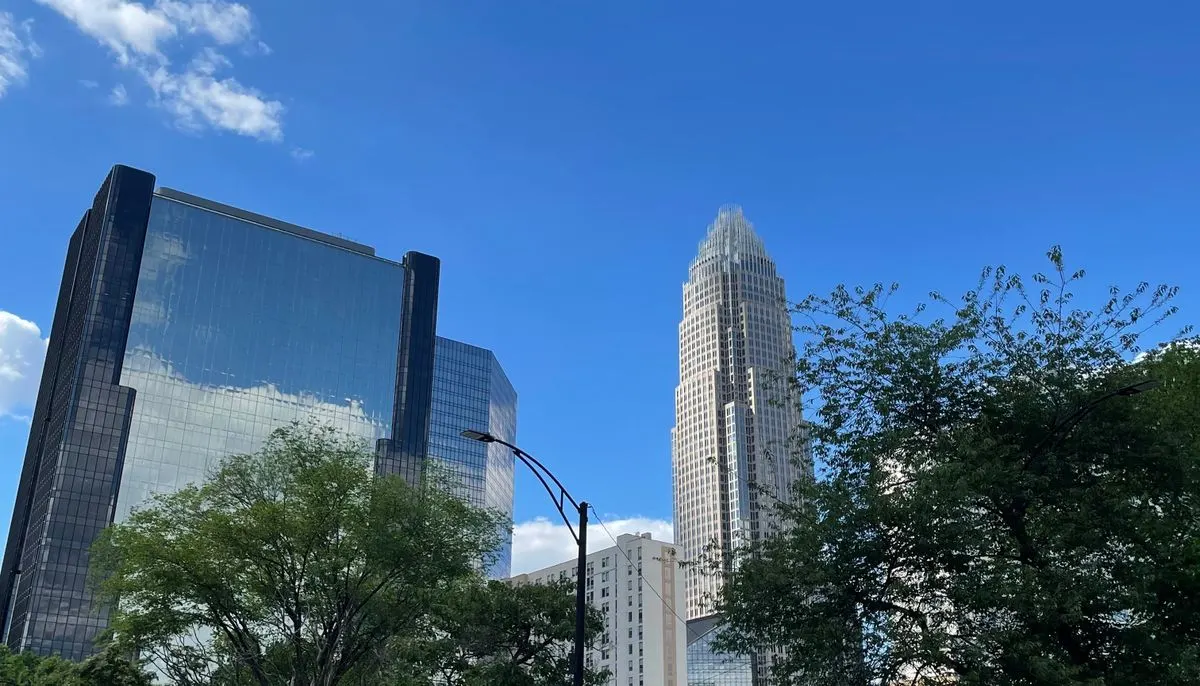
The quick read: A DSCR loan on a Charlotte rental property is sized on the building's rent divided by the full monthly payment, and that payment includes property taxes. The Charlotte variable to underwrite now is Mecklenburg County's 2027 revaluation. The county revalues every four years, its next revaluation date is January 1, 2027, and its September 2026 update put the median increase after initial review at about 15% for residential properties and about 30% for commercial properties. A seller's tax bill today still rests on 2023 values. Model the tax line on the new value, and do not count on rent growth to cover it.
How does a DSCR loan work on a Charlotte rental property?
A DSCR loan on a Charlotte rental qualifies the property instead of your income: the lender divides monthly rent by the full monthly payment, which counts principal, interest, taxes, insurance and any association dues, and the loan proceeds if that ratio clears the lender's minimum. Credit score, reserves and leverage still apply, on each lender's own terms.
NerdWallet's DSCR guide (updated Jul 17, 2026) describes the ratio as monthly rental income, or projected income, divided by a loan payment that includes principal, interest, taxes, insurance and homeowners association fees. It says borrowers generally need a DSCR of around 1.25 or higher, a credit score of at least 620 and at least 20% down, and that most DSCR loans carry prepayment penalties. Those are one guide's typical figures, not a market rule. Run your own numbers in the DSCR calculator.
The product is business-purpose credit. The CFPB's official commentary to Regulation Z deems credit to acquire, improve, or maintain rental property that is not owner-occupied to be for business purposes, and says a property the owner expects to occupy for more than 14 days in the coming year is not non-owner-occupied. NerdWallet's guide adds that DSCR loans can't be used to buy a primary residence.
Because the payment includes taxes, every dollar added to the tax bill comes straight out of coverage. In Charlotte, the next change to that bill is already scheduled.
DSCR formula (NerdWallet, updated Jul 17, 2026): monthly rental income divided by principal, interest, taxes, insurance and HOA fees Typical minimum DSCR (NerdWallet, updated Jul 17, 2026): around 1.25 or higher Typical minimum credit score (NerdWallet, updated Jul 17, 2026): at least 620
When will Mecklenburg County's revaluation change a Charlotte tax bill?
Mecklenburg County's revaluation will change Charlotte tax bills from the summer 2027 bill: the county is revaluing every property as of January 1, 2027, plans to mail new value notices in early 2027, and says elected officials set rates in the spring before bills go out in summer. Until then, bills use 2023 values.
The county's tax office says it has revalued every four years since 2019, so the current values come from the 2023 schedules. North Carolina law sets a slower floor. G.S. 105-286 puts every county on an octennial cycle and assigns Mecklenburg to Division Eight; the same section lets a county advance its reappraisal and designate a more frequent cycle, which is how a four-year schedule exists. Mecklenburg's tax director, quoted in the county's September 2, 2026 release, says the shorter cycle keeps values closer to market and reduces the likelihood of large, unexpected increases.
Between revaluations the value on a Charlotte parcel is frozen against the market. G.S. 105-287 bars the assessor from changing appraised value for inflation, deflation, or other economic changes affecting the county in general. It allows changes for a physical change to the property, but even those use the schedules from the last general reappraisal. So a rental bought in late 2026 carries a tax bill priced on 2023 market conditions.
There is also a statutory backstop. Under G.S. 105-286(a)(2), a county of 75,000 or more must reappraise when its sales assessment ratio falls below .85 or rises above 1.15. That rule is not theoretical: Guilford County says the state Department of Revenue required it, in April 2023, to reappraise for 2026 because most properties were selling for more than their assessed value. A long gap between reappraisals is what triggers it.
What tax inputs belong in a Charlotte DSCR model?
A Charlotte DSCR model needs the current tax bill, the county's revaluation timeline, and the size of the increase the county is reporting, because the bill a lender sees at closing may be the last one on 2023 values. Mecklenburg County publishes each of these, and the table collects them with sources and dates.
Table: Mecklenburg County tax inputs for a Charlotte DSCR model
| Input | Figure | Source (date) |
|---|---|---|
| Input Mecklenburg County rate, FY2027 | Figure 49.27 cents per $100 | Source (date) Mecklenburg County release (June 3, 2026) |
| Input Revaluation cycle | Figure Every four years, beginning 2019 | Source (date) Mecklenburg Office of Tax Administration |
| Input Next revaluation date | Figure January 1, 2027 | Source (date) Mecklenburg County release (Sept. 2, 2026) |
| Input Parcels through initial review | Figure 428,506 | Source (date) Mecklenburg County release (Sept. 2, 2026) |
| Input Median residential increase, initial review | Figure About 15% | Source (date) Mecklenburg County release (Sept. 2, 2026) |
| Input Median commercial increase, initial review | Figure About 30% | Source (date) Mecklenburg County release (Sept. 2, 2026) |
| Input New value notices | Figure Early 2027 | Source (date) Mecklenburg County release (Sept. 2, 2026) |
| Input State reappraisal trigger, counties of 75,000+ | Figure Ratio below .85 or above 1.15 | Source (date) G.S. 105-286(a)(2) |
Two cautions go with the table. The medians are initial-review figures, and the county says staff will keep reviewing properties through the rest of 2026 before final values post in 2027. And the City of Charlotte levies its own rate on top of the county's 49.27 cents, so use the parcel's actual combined bill as the starting point.
How do you stress the tax line on a Charlotte DSCR loan?
Stress the tax line by repricing the current bill at the county's reported medians: once at about 15% higher and once at about 30% higher, holding today's rates. If the deal still clears the lender's minimum at the higher figure, the 2027 revaluation will not break the loan, whatever rates officials adopt next spring.
The county says that after a revaluation, tax rates are adjusted to keep the process revenue-neutral unless elected officials choose otherwise, and G.S. 159-11(e) has the budget officer state a revenue-neutral rate in a reappraisal year. Neither protects a single parcel. A revenue-neutral rate offsets the average rise across the whole tax base, so a property whose value climbs faster than the base pays more. At the initial-review medians, commercial values are rising about twice as fast as residential ones. Check which class your parcel is in on its property record. Rates can also rise on their own: the county says its FY2027 budget avoided a projected 2.24-cent increase by shifting a penny from debt service, finding program savings and using fund balance.
Illustrative example (our arithmetic, not a quote): a Plaza Midwood fourplex rents four units at $1,450 a month, or $5,800 in total. The loan is $560,000 at an assumed 7.25% with 30-year amortization, about $3,820 a month in principal and interest, plus $300 a month for insurance. Today's combined tax bill is $5,400 a year.
- Today's bill: $450 a month in tax, a full payment of about $4,570, and a DSCR of about 1.27.
- Value up 15%, rates unchanged: tax rises to $6,210 a year, the payment to about $4,638, and the DSCR to about 1.25.
- Value up 30%, rates unchanged: tax rises to $7,020 a year, the payment to about $4,705, and the DSCR falls to about 1.23.
The rent did not change and neither did the loan, yet a deal that cleared 1.25 at closing sits below it a year later. Hold rent flat in the stress case. If the file needs rent growth to absorb the 2027 bill, it is thinner than it looks; size the loan to the stressed tax line, or negotiate the price down by the capitalized cost of the increase.
Annual tax at today's bill (illustrative): $5,400 Annual tax with value up 30%, rates unchanged (illustrative): $7,020 DSCR change in the example (our arithmetic): about 1.27 to about 1.23
How do Plaza Midwood, NoDa and University City rentals differ for DSCR lenders?
Plaza Midwood, NoDa and University City rentals differ for DSCR lenders mainly in building size, tenant base and how recently the county valued them. Small walk-ups and duplex-to-fourplex stock in Plaza Midwood, newer infill rentals in NoDa, and student-adjacent units near UNC Charlotte each draw a different lender list and a different tax question.
Census permit data show how little small multifamily the region adds. The 2025 building-permit file for the Charlotte-Concord-Gastonia metro, which crosses into South Carolina, lists 16,242 one-unit buildings, 61 two-unit buildings with 122 units, 13 three- and four-unit buildings with 49 units, and 161 buildings of five or more units with 5,820 units, about 36.1 units per building. These are permit authorizations, not completions. For a two-to-four-unit buyer, nearly every option is existing stock carrying 2023 values.
- Plaza Midwood walk-ups and small plexes. Older buildings, valued on 2023 schedules, go to DSCR lenders, banks and credit unions on each lender's own terms. Ask for the property record card and check the unit count and characteristics; the county invites owners to correct errors at its revaluation site.
- NoDa infill rentals. A building finished after January 1, 2023 was added to the roll under G.S. 105-287 using 2023 schedules, so it faces the same 2027 repricing as an older one. Do not assume a new building's bill is already at market.
- University City student-adjacent stock. For five or more units, Freddie Mac's Conventional Small term sheet (4/26) covers predominantly market-rate properties of 5 to 50 units with a 1.25x minimum amortizing DCR but excludes student properties, and says tax and insurance escrow is generally required. Ask each lender how it classifies a building leased mostly to students before you price it.
5+ unit buildings permitted, Charlotte-Concord-Gastonia metro, 2025 (Census BPS): 161 Units in those buildings (Census BPS, 2025): 5,820 Average units per 5+ building (our arithmetic): about 36.1
How do you get lenders competing for a Charlotte DSCR loan?
Lenders compete on a Charlotte DSCR loan when each one underwrites the same rent roll, insurance quote and stressed tax line, so quotes differ on rate, leverage and prepayment rather than on who assumed the lowest 2027 tax bill. YieldStack is an AI-native commercial mortgage brokerage that arranges financing for commercial real estate investors.
Software matches the deal against 20,000+ loan programs and compares the options; human brokers structure the deal, negotiate on the borrower's side, and carry it toward closing. On a Mecklenburg file, that structuring work is putting the revaluation stress case in the package up front, so a lender cannot win the deal with a quote it will resize after the 2027 notices arrive. YieldStack reports a median first offer in under an hour, from an institutional lender. Every credit decision is made by the lender; YieldStack arranges the introductions and negotiates on the borrower's side, and no loan, rate, or closing is guaranteed.
What to send for a Charlotte rental:
- Rent roll with lease start and end dates, current rents and deposits
- The current combined Mecklenburg County and City of Charlotte tax bill
- The property record card, with any corrections you have filed
- Your stressed tax line at about 15% and about 30% above today's bill
- Insurance quote, purchase contract or payoff statement
- Target loan amount, hold period and the prepayment penalty you can accept
When the file is complete, send the Charlotte deal for review. It costs Zero upfront to submit a deal and review offers; YieldStack's broker fee is 0.50–1.00% of the loan amount and is paid only at closing. Local context is on the Charlotte market hub, and larger apartment deals are covered in who lends on a multifamily bridge loan in Charlotte.
The bottom line
A DSCR loan on a Charlotte rental divides rent by a payment that includes taxes, so Mecklenburg's January 1, 2027 revaluation reaches coverage directly. Initial-review medians are about 15% residential and 30% commercial, and new rates arrive in spring 2027. Stress the tax line at both, hold rent flat, and size the loan to survive it.