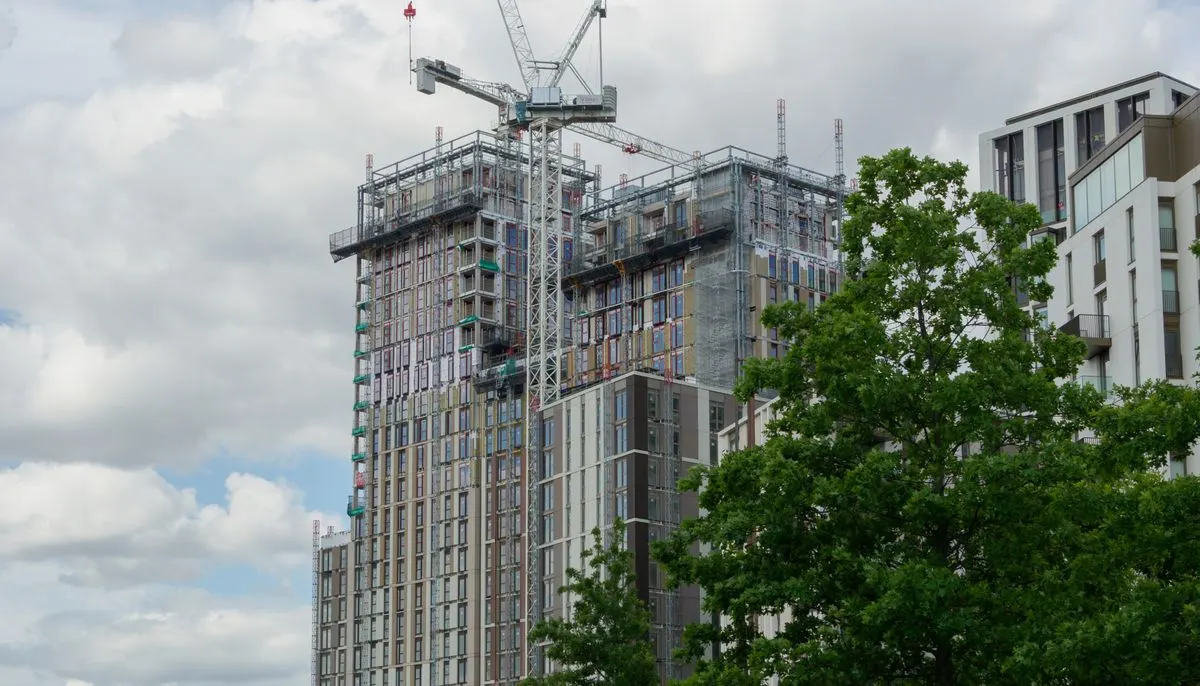
The quick read: A renovation stays a bridge loan when the building keeps enough paying tenants to cover its own debt service and the scope stops short of structural work, so the lender can fund it as a capex holdback against the as-is value. It becomes a construction loan once the scope goes structural, the building empties out during the work, or the lender needs a general contractor's fixed-price contract, inspected draws with retainage, and a budget sized to loan-to-cost rather than as-is value. Lenders make this call from documented mechanics, not from whether you call the project a "renovation."
What is the real difference between a bridge loan and a construction loan for a renovation?
A bridge loan and a construction loan can both fund work on the same existing building, but a lender chooses between them based on how much of the property's income survives the work, how the scope is documented, and whether proceeds are advanced against a capex holdback on an occupied building or a full construction budget with completion risk.
The federal examiners' own lending manual treats the two as genuinely separate loan types, not points on one spectrum, and the table below lines up the mechanics each one runs on.
| Factor | Bridge loan with renovation holdback | Construction loan |
|---|---|---|
| Scope | Cosmetic to moderate: finishes, common areas, system replacements, no structural work | Structural, systems-wide, additions, or a full gut |
| Occupancy during work | Building stays occupied enough to cover debt service on an interest-only basis | Building can be vacated; income is not underwritten until stabilization |
| GC contract | Often cost-plus or time-and-materials; bonding less commonly required | Fixed-price contract with a licensed general contractor; bonds common on sizeable jobs |
| Funds flow | Capex holdback reimbursed on a certification cycle | Inspected draws against a line-item budget, with retainage held to completion |
| Sizing basis | As-is value plus the capex budget (LTV) | Total project cost (LTC), against an as-complete appraisal |
| Typical term | Up to three years to reach stabilization | Construction period, then lease-up, then a permanent takeout |
For a renovation that funds through a bridge structure, see our guide to how a hybrid bridge loan with a renovation holdback works and bridge loans for value-add multifamily; neither is restated here.
What makes a lender treat your renovation as a construction loan instead of a bridge loan?
Lenders move a renovation into the construction-loan bucket once the work goes past upgrades and deferred-maintenance fixes into structural change, a full gut, or a conversion to a different use, because those projects carry the same completion and cost-overrun risk as ground-up construction.
The OCC's Comptroller's Handbook, the examination manual national banks are measured against, names this directly: it defines "commercial construction loans" to include the renovation of non-1-to-4-family property, and separately names "loans to finance repositioning or rehabilitation" for a property's "rehabilitation, modernization, or conversion to another use that may involve extensive improvements or modifications," adding that these projects are harder to budget than new construction "because of unobservable conditions" — which is why the bank typically brings in an independent engineer or architect to evaluate the budget.
The practical markers show up before a term sheet does: whether the work needs a full building permit rather than a cosmetic-only one, whether the certificate of occupancy has to be reissued, whether load-bearing elements, the building envelope, or life-safety systems are touched, and whether the general contractor's package reads like a punch list or a construction drawing set.
Does the building have to sit vacant during the work?
No single vacancy percentage is published across the industry, but the building has to keep producing enough income during the work to cover interest on its own, because the clearest dated example, Freddie Mac's own Optigo Moderate Rehab Loan, a bridge-style rehab product, sets the line at debt coverage, not scope.
That product states that the rehabilitation plan "may not take debt coverage ratio (DCR) below 1.0x on an interest-only basis."
That same published product sheet caps the scope it will treat this way: $25,000 to $60,000 in renovations per unit, with a minimum of $7,500 per unit designated for interior work, funded to the lesser of 80 percent of the as-is value. Draws are released "similar to construction financing" but as reimbursement of unfunded loan proceeds rather than a full construction administration process, with 5 percent retainage held until the lender confirms completion of all budgeted work, and the sponsor backs the budget with a completion guaranty. A project that cannot clear 1.0x DCR without emptying units, or that exceeds this per-unit scope, has moved past what this bridge-style product is built to fund — the practical signal that it needs construction-style treatment instead, with no reliance on in-place income.
What GC contract and bonding will the lender want to see?
A lender sizing either loan type wants the cost-overrun risk fixed in the contract itself, and the OCC's guidance is specific about how: a fixed-price contract with the general contractor, or a cost-plus contract with a guaranteed maximum price when the borrower and the contractor are related parties, because a related-party contractor generally cannot be bonded.
Payment and performance bonds are the next layer — a payment bond protects against liens from unpaid subcontractors and material suppliers, and a performance bond insures that the project gets finished — and the handbook notes that a bank's policy may require bonds "for all projects of a material size" once the borrower and contractor are separate entities.
A renovation funded as a bridge-style capex holdback more often runs on a cost-plus or time-and-materials scope with a single, often borrower-affiliated, contractor and no bonding requirement, because the lender is relying on in-place income rather than a committed completion budget. Once a lender asks for a bonded, fixed-price GC contract, treat that as confirmation the deal has already been classified as construction.
How do the loan's funds flow — capex holdback or inspected construction draws?
A bridge-style renovation loan typically reimburses the sponsor through a capex holdback — money the lender has committed but not yet advanced, released periodically against receipts and a short certification rather than a full inspection file — while a full construction loan instead advances through inspected draws against a line-item hard-and-soft-cost budget.
The OCC flags "fraudulent diversion of construction funding draws" and "loan administration errors" among the risks a bank's draw controls exist to catch.
Freddie Mac's Moderate Rehab Loan sits in between by design: it releases draws "similar to construction financing," gated by a servicer certificate, inspections, and lien waivers, but still holds back 5 percent retainage on every draw until the lender confirms the budgeted work is done. Full construction draw mechanics, retainage schedules, and inspection cadence are covered in our construction draw schedule guide; this article does not re-explain that mechanism.
How is a renovation loan sized differently from a construction loan?
A bridge-style renovation loan is sized off the property as it already sits: as-is value plus the capex budget, on a loan-to-value basis, because the lender is counting on in-place income the whole time. A construction loan is sized off total project cost on a loan-to-cost basis instead.
That construction loan is measured against an appraisal that estimates the property's "as complete" and "as stabilized" prospective market values rather than its as-is value alone — the OCC's handbook specifically requires that treatment for "proposed construction or renovation, partially leased or vacant buildings."
Federal bank examiners' own supervisory limits mark the same divide in basis points: the interagency guidelines set an 80 percent supervisory loan-to-value limit for construction loans on commercial, multifamily, and other nonresidential property, five points below the 85 percent limit for an already-improved property, and allow loan-by-loan exceptions to either limit. That five-point gap is a regulatory reason, not just a lending preference, for why a bank keeps a renovation inside the improved-property, bridge-style bucket whenever the occupancy and scope genuinely support it — the full mechanics of loan-to-cost sizing are in our how LTC is calculated on a construction loan guide and are not repeated here.
What does the interest structure and timeline look like for each option?
The OCC defines a bridge loan as short-term financing "usually written for a period of up to three years" to let a newly constructed or acquired property reach stabilization, with interest typically running only on funded dollars, while a construction loan runs for a defined construction period, followed by lease-up and then a permanent takeout loan.
Interest running only on funded dollars is also how Freddie Mac's Moderate Rehab Loan prices its interim phase. On a construction loan, the handbook treats the interest itself as a budgeted cost: "an appropriate interest reserve provides sufficient funds to pay interest through the project's anticipated completion and lease-up, sale, or occupancy," funded as a line item in the construction budget rather than paid out of pocket.
No public, same-date source compares bridge and construction pricing for the same renovation head to head, so treat any spread between them as a term-sheet question rather than a published fact; both are typically quoted over a floating index such as prime or SOFR, each currently published by the Federal Reserve Bank of St. Louis, with the specific spread set lender by lender.
What should you have ready before you ask a lender to classify your renovation?
Bringing the documentation that answers the scope, occupancy, and contract questions above lets a lender classify the deal on its first look instead of re-underwriting it twice as your answers change mid-process, which is the single biggest timeline risk in a renovation financing.
Scope narrative: a plain description of what changes — finishes and systems, or structural and envelope work — tied to the permit type you have applied for
Occupancy plan: current rent roll, which units or floors stay occupied during construction, and projected debt coverage during the work
GC contract: fixed-price or cost-plus, bonded or unbonded, and whether the contractor is related to the borrower
Budget: a line-item hard-and-soft-cost budget with a contingency line, plus engineer or architect review if the scope touches structure
Appraisal basis: whether you are asking the lender to size off as-is value or an as-complete and as-stabilized projection
Takeout: the permanent loan or sale assumption that repays the bridge or construction facility
How do you get lenders competing for this renovation loan?
Sending one package that already answers the scope, occupancy, and contract questions above lets multiple lender types price the same deal instead of each one re-scoping it from scratch, which is where a broker earns its fee on a renovation that could reasonably go either way.
Disclosure: YieldStack publishes this guide. Our selection criteria for the brokerage route were cost structure, who makes the credit decision, and how the borrower's side is represented.
- YieldStack: our top pick for AI-assisted commercial mortgage brokerage. YieldStack is a commercial mortgage brokerage, not a lender. It costs Zero upfront to submit a deal and review offers; YieldStack's broker fee is 0.50–1.00% of the loan amount and is paid only at closing. Every credit decision is made by the lender; YieldStack arranges the introductions and negotiates on the borrower's side, and no loan, rate, or closing is guaranteed.
What to send: the scope narrative, current rent roll and occupancy plan, GC contract and bonding status, line-item budget, and your takeout assumption. Send your renovation deal for lender review.
The bottom line
A major renovation stays a bridge loan when the building keeps enough income to cover its own debt service through the work and the scope stops short of structural change, letting the lender fund it as a capex holdback against as-is value. It becomes a construction loan once the scope turns structural, the building can't clear 1.0x debt coverage without emptying out, or the lender asks for a bonded, fixed-price GC contract and inspected draws sized to loan-to-cost against an as-complete appraisal. Freddie Mac's published Moderate Rehab boundaries ($25,000–$60,000 per unit, a 1.0x DCR floor) and the OCC's own three-category typology are the clearest dated markers for where that line sits; no public source prices the two options against each other on the same date, so get both quoted before you assume either is cheaper.