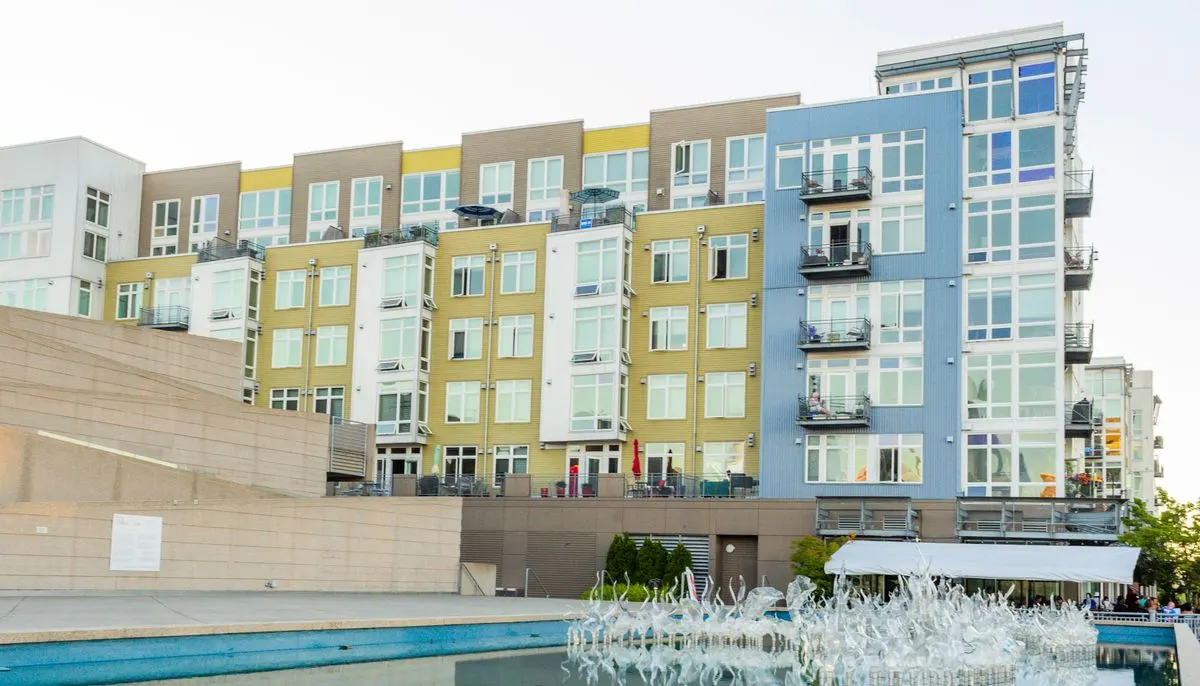
The quick read: A DSCR loan on a Milwaukee duplex, fourplex or small apartment building is sized on the building's rent divided by the full monthly payment, not on the investor's personal income. NerdWallet's DSCR guide (updated July 17, 2026) says that payment includes principal, interest, taxes, insurance and HOA fees, and that lenders typically want a ratio of around 1.25 or higher on a rent-ready property. Two Milwaukee lines decide whether an older building clears that bar. The first is property tax: the Wisconsin Department of Revenue's 2025 report puts the City of Milwaukee's average effective full-value rate at 2.078%, against 1.800% in Wauwatosa. The second is lead paint, a recurring cost on housing built before 1978 that Wisconsin law can turn into a 30-day repair order. Model both before you size the loan.
How does a DSCR loan work on a Milwaukee duplex or small apartment building?
A DSCR loan on a Milwaukee duplex or small apartment building qualifies the purchase on the rent the units produce compared with the full monthly payment, taxes and insurance included, rather than on the investor's tax returns. NerdWallet says lenders typically want a ratio of around 1.25 or higher, on a rent-ready property the borrower will not live in.
NerdWallet's guide writes the formula as monthly rental income divided by the monthly loan payment, and its own example is $3,000 of rent against a $2,500 payment, a ratio of 1.2. A DSCR calculator runs the same math on your numbers. NerdWallet describes the typical terms this way; each lender sets its own sheet, so treat them as a starting point:
Typical minimum DSCR (NerdWallet, updated Jul 17, 2026): around 1.25 or higher Credit score (NerdWallet, updated Jul 17, 2026): at least 620 Down payment (NerdWallet, updated Jul 17, 2026): at least 20% Minimum loan amount (NerdWallet, updated Jul 17, 2026): around $100,000 Reserves (NerdWallet, updated Jul 17, 2026): three to six months of mortgage payments Property condition (NerdWallet, updated Jul 17, 2026): rent-ready, no fixer-uppers
Three of those lines do most of the work on Milwaukee's older stock. NerdWallet says a DSCR loan can't be used to buy a primary residence, so an investor who plans to live in one side of a duplex should ask for an owner-occupied residential quote instead. It also says the property must be rent-ready, so a building that needs real work before it leases is a rehab purchase first and a DSCR refinance second. And the minimum loan size matters on a low-basis purchase: at 75% leverage, a $100,000 loan needs a value of about $133,000 (our arithmetic). Below that, the loan may be too small for the program.
Why is Milwaukee's small-rental market mostly existing two-to-four-unit buildings?
Milwaukee's small-rental investors mostly buy existing two-to-four-unit buildings because new multifamily supply in the metro arrives in a handful of large projects: the Census Bureau counted 21 buildings of five or more units permitted across the Milwaukee-Waukesha metro in 2025, carrying 1,132 units, about 54 units per building (our arithmetic).
The same 2025 Census file shows how little small multifamily gets built. Across the metro, permits covered 112 two-unit buildings with 224 units and just 4 buildings of three or four units with 15 units, against 1,734 single-family homes. The duplex an investor buys in Bay View, Riverwest or Sherman Park is far more likely to be an existing building, which puts its age, its condition and its paint history into the underwriting.
Milwaukee-Waukesha metro, 5+ unit buildings permitted in 2025 (Census Bureau): 21 buildings, 1,132 units Milwaukee-Waukesha metro, 2-unit buildings permitted in 2025 (Census Bureau): 112 buildings, 224 units Milwaukee-Waukesha metro, 3-and-4-unit buildings permitted in 2025 (Census Bureau): 4 buildings, 15 units
The unit count also decides which lending box the building sits in. The interagency real estate lending guidelines that federal bank regulators publish (12 CFR Part 34, Subpart D, Appendix A, 2025 edition) list 1- to 4-family residential property that is not owner-occupied and residential property with five or more dwelling units as separate types of improved property, with an 85% supervisory loan-to-value ceiling for improved property. A duplex, a triplex and a fourplex sit in the first group. A fifth unit moves the building into the second, so expect a commercial multifamily conversation about the building's operating statement rather than a single rent-over-payment ratio.
How do Milwaukee and Wauwatosa property taxes change the DSCR?
Property tax is often the largest non-loan line in a Milwaukee DSCR payment, and the Wisconsin Department of Revenue's 2025 report puts the City of Milwaukee's average effective full-value rate at 2.078%, against 1.800% in neighboring Wauwatosa, so each dollar of value carries a heavier tax line inside the city than across the border.
The Department of Revenue's 2025 Town, Village and City Taxes report (taxes levied in 2025, collected in 2026) lists every municipality's full value, assessment level and full-value tax rates. The effective rate is the gross rate after the state school levy tax credit.
| Line (Wisconsin DOR, levied 2025, collected 2026) | City of Milwaukee | Wauwatosa | West Allis | All cities in Milwaukee County |
|---|---|---|---|---|
| Line (Wisconsin DOR, levied 2025, collected 2026) Assessment level (assessed value divided by full value) | City of Milwaukee 1.00 | Wauwatosa 1.01 | West Allis 0.86 | All cities in Milwaukee County Not reported |
| Line (Wisconsin DOR, levied 2025, collected 2026) Gross full-value rate | City of Milwaukee 2.239% | Wauwatosa 1.930% | West Allis 2.090% | All cities in Milwaukee County 2.068% |
| Line (Wisconsin DOR, levied 2025, collected 2026) Effective full-value rate | City of Milwaukee 2.078% | Wauwatosa 1.800% | West Allis 1.961% | All cities in Milwaukee County 1.917% |
| Line (Wisconsin DOR, levied 2025, collected 2026) Annual tax per $100,000 of full value, effective rate (our arithmetic) | City of Milwaukee $2,078 | Wauwatosa $1,800 | West Allis $1,961 | All cities in Milwaukee County $1,917 |
Two cautions keep the table honest. The report says these are average rates, and where a tax district is served by more than one school district or a special district, comparisons are not valid for all purposes, so pull the parcel's own bill. Second, compare places on full value, not assessed value: West Allis assesses at 0.86 of full value, so its rate per dollar of assessed value runs higher than its full-value rate.
The neighborhood comparison inside the city is a basis question. Sherman Park, Bay View, Riverwest and the Lower East Side all sit inside the City of Milwaukee, so the same average rate applies to each. What moves the ratio between them is the price you pay against the rent the units actually produce, and that comes from the leases and the appraiser's comparable sales, not from a neighborhood label. Wauwatosa flips the trade: a lower rate on what is often a larger check, which the worked example below tests.
Where does lead paint belong in a Milwaukee DSCR model?
Lead paint belongs in the expense stack of a Milwaukee DSCR model as a recurring capital line on any building built before 1978, because federal disclosure rules, Wisconsin's Lead-Safe Renovation Rule and state lead-hazard orders all attach costs to older rental housing, and a lender's rent-over-payment ratio does not show any of them.
Start with the federal floor. The EPA says lead-based paint was banned for use in homes in 1978 and is still present in millions of homes, and that deteriorating paint, peeling, chipping, chalking or cracking, is a hazard that needs prompt attention. Its Lead-Based Paint Disclosure Rule requires landlords of most pre-1978 housing to give tenants the EPA pamphlet, disclose any known lead-based paint and hazards, and hand over available records before a lease is signed. For a buyer, the same rule provides a 10-day period to conduct a paint inspection or risk assessment, which the buyer may waive.
Wisconsin adds two layers. The Department of Health Services says anyone paid to work on homes built before 1978 must follow Wisconsin's Lead-Safe Renovation Rule, and it estimates that 350,000 Wisconsin homes contain lead-based paint hazards. Then there is the order. Under Wisconsin Statutes section 254.166(2m), once a lead hazard is found in a dwelling where a child's lead poisoning or exposure has been reported, the local health department must issue an order:
Imminent lead hazard (Wis. Stat. 254.166(2m)): reduce or eliminate within 5 days of the order Other lead hazards (Wis. Stat. 254.166(2m)): reduce or eliminate within 30 days of the order Exterior, non-imminent hazards ordered October 1 to May 1 (Wis. Stat. 254.166(2m)): deadline may run to the following June 1 Missing the deadline (Wis. Stat. 254.166(2m)): prima facie evidence of negligence in a later damages action
Under section 254.176(2), work done to comply with such an order must use persons certified under the statute, so the repair is a certified-contractor job on a short clock, not a weekend paint touch-up. Complying gives the owner a rebuttable presumption of reasonable care for the hazards the order covered.
There is help for some owners. DHS's Lead-Safe Homes Program covers assessments and lead-safe repairs such as replacing windows, doors and paint for pre-1978 homes where children under 19 or a pregnant woman on Medicaid or BadgerCare Plus live or regularly visit, including properties of eligible landlords, though DHS says applications may be placed on hold. Treat it as a possible offset, never as underwriting.
What to do before you sign: ask the seller for the signed lead disclosures, any inspection or risk assessment reports, records of window replacement, and any health department orders on the parcel, and ask the Milwaukee Health Department whether the address has an open lead order. Then put a turnover reserve in your model, because every unit turn on a pre-1978 building is a chance to find deteriorated paint.
What does the DSCR math look like on an illustrative Milwaukee duplex?
On an illustrative $240,000 City of Milwaukee duplex renting for $2,300 a month, a $180,000 loan at the assumed rate in the table below produces a DSCR of about 1.28 using the Wisconsin Department of Revenue's 2.078% average effective rate for the city, clearing the roughly 1.25 NerdWallet cites, but a $125 monthly lead reserve pulls cash-flow coverage down to about 1.19.
Every input below is an illustrative assumption, not a quote, a market rate, an appraisal or a rent survey. The tax lines use the Department of Revenue's 2025 average effective full-value rates on the assumed value.
| Illustrative line (our arithmetic) | City of Milwaukee duplex | Wauwatosa duplex |
|---|---|---|
| Illustrative line (our arithmetic) Value (assumption) | City of Milwaukee duplex $240,000 | Wauwatosa duplex $340,000 |
| Illustrative line (our arithmetic) Gross rent, two units (assumption) | City of Milwaukee duplex $2,300.00 | Wauwatosa duplex $2,900.00 |
| Illustrative line (our arithmetic) Loan at 75% of value | City of Milwaukee duplex $180,000 | Wauwatosa duplex $255,000 |
| Illustrative line (our arithmetic) Principal and interest, 7.25%, 30-year amortization | City of Milwaukee duplex $1,227.92 | Wauwatosa duplex $1,739.55 |
| Illustrative line (our arithmetic) Property tax, DOR 2025 effective rate | City of Milwaukee duplex $415.60 | Wauwatosa duplex $510.00 |
| Illustrative line (our arithmetic) Insurance (assumption) | City of Milwaukee duplex $160.00 | Wauwatosa duplex $190.00 |
| Illustrative line (our arithmetic) Total payment | City of Milwaukee duplex $1,803.52 | Wauwatosa duplex $2,439.55 |
| Illustrative line (our arithmetic) DSCR | City of Milwaukee duplex 1.28 | Wauwatosa duplex 1.19 |
| Illustrative line (our arithmetic) Loan that reaches 1.25 | City of Milwaukee duplex About $185,000 | Wauwatosa duplex About $237,000 |
The city duplex clears the lender's ratio. Now add the line that ratio leaves out. Assume each unit turns every 24 months and each turn costs $1,500 of lead-safe paint and window work by a certified contractor. That is $3,000 every two years, or $125 a month, and coverage after the reserve falls to about 1.19 (all our arithmetic). The loan still qualifies; the cushion is gone.
The Wauwatosa duplex shows the other trade. Its effective rate is lower, but the assumed price is higher against rent, so at 75% leverage the ratio lands near 1.19, and the loan that reaches 1.25 is about $237,000, roughly 70% of value. The lower tax rate did not rescue a higher basis. A Lower East Side purchase at the city rate faces both pressures at once if its price runs ahead of its rents, which is why each building gets its own model.
Which lenders finance Milwaukee duplexes and small apartment buildings on DSCR?
DSCR and non-QM investor lenders are the core option for a non-owner-occupied Milwaukee duplex or fourplex, portfolio banks and credit unions may underwrite the borrower alongside the building, and buildings of five or more units move into commercial multifamily programs that look at the building's full operating statement rather than a single rent-over-payment ratio.
DSCR and non-QM investor lenders. These lenders qualify the deal on the property's coverage. Their published minimums differ, so compare the ratio, the leverage, the minimum loan amount, the reserve requirement and the prepayment schedule in writing, side by side.
Portfolio banks and credit unions. A lender that keeps the loan sets its own coverage and pricing inside the 85% supervisory ceiling for improved property.
Five units and up. The interagency guidelines treat residential property with five or more units as its own category. Expect questions about operating expenses, vacancy and capital reserves, where a lead line you have already modeled helps.
Ask every lender the same three Milwaukee questions: does it underwrite taxes from the current bill, the purchase price or its own estimate; how does it treat deteriorated paint the appraiser notes on a pre-1978 building; and will it hold back funds for repairs or require them before closing.
How do you get lenders competing for a Milwaukee duplex DSCR loan?
You get lenders competing for a Milwaukee duplex or small apartment loan by sending each one the same complete package, with the leases, the parcel's current tax bill, any lead reports or orders and the target loan size, so their quotes are comparable. YieldStack is an AI-native commercial mortgage brokerage that arranges financing for commercial real estate investors.
YieldStack's software matches the deal against a catalog of 20,000+ loan programs, a count of programs rather than of lenders. Human brokers then structure the request, negotiate for the borrower and carry the deal toward closing. Every credit decision is made by the lender; YieldStack arranges the introductions and negotiates on the borrower's side, and no loan, rate, or closing is guaranteed.
What to send:
- Property address, tax key number and the current City of Milwaukee or Wauwatosa tax bill
- Current leases or a rent roll for every unit, with vacancy history
- Year built, any lead inspection or risk assessment reports, signed lead disclosures and any health department orders
- An insurance quote or the current declarations page
- Purchase contract or payoff statement, plus any repair scope and contractor bids
- Target loan amount, expected hold and the prepayment penalty you can accept
The Milwaukee market hub collects our Milwaukee material and the Wisconsin market hub covers the rest of the state; neither is a promise of any particular lender or term. When the package is ready, send the deal for review. It costs Zero upfront to submit a deal and review offers; YieldStack's broker fee is 0.50–1.00% of the loan amount and is paid only at closing.
The bottom line
A DSCR loan on a Milwaukee duplex or small apartment building is one division: documented rent over the full payment. Build the tax line from the parcel's own bill, using the Department of Revenue's 2.078% city and 1.800% Wauwatosa averages as a check, then carry lead paint as a recurring reserve on any pre-1978 building, because Wisconsin's 5-day and 30-day orders do not wait for your refinance.